

The Statement Before the Story
Melania Trump went to the White House podium today. The question is why she had to.

Melania Trump did not issue a written statement through a press office.
She walked into the Grand Foyer of the White House, stood at a podium, and read a prepared speech on camera. For a First Lady who has spent years carefully rationing her public appearances, a televised statement from inside the White House is the institutional equivalent of a five-alarm response.
Donald Trump told MSNBC he didn’t know about it beforehand. Several of her own staff, per NBC News, didn’t know what she would say.
Make of that what you will. Either she went rogue, which is its own story, or the White House is performing distance from a statement it absolutely helped craft. Neither option is boring. Both are worth tracking.
What she said, stripped of the framing: she was never friends with Epstein. She and Donald attended some of the same parties because “overlapping in social circles is common in New York City and Palm Beach.” She first crossed paths with Epstein in 2000, at an event she attended with Trump. She acknowledged the email to Maxwell — called it “casual correspondence,” a “trivial note” — and moved on. She denied being a victim. She denied that Epstein introduced her to her husband.
Then she called on Congress to hold public hearings for Epstein’s survivors.
We’ll come back to that.
The Email She Called a Trivial Note
The email in question comes directly from the publicly released FBI Epstein files.
It reads: “Dear G! How are you? Nice story about JE in NY mag. You look great on the picture. I know you are very busy flying all over the world. How was Palm Beach? I cannot wait to go down. Give me a call when you are back in NY. Have a great time! Love, Melania.”
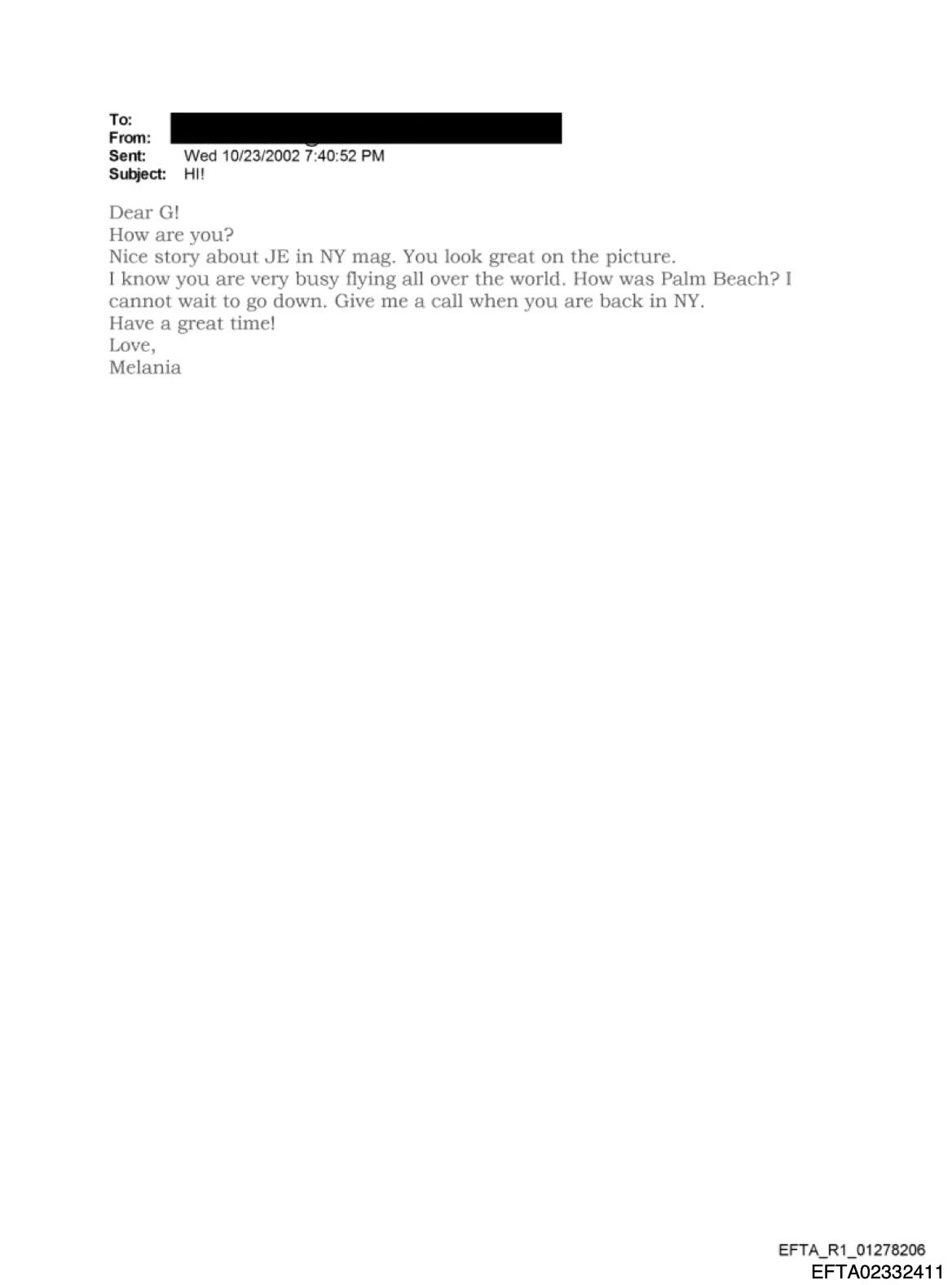
This was sent in October 2002 — the same month a New York Magazine profile ran on Epstein in which Donald Trump called him a “terrific guy.”
The sender and recipient were blacked out in the original release. The email ends “Love, Melania” and begins “Dear G.” The DOJ and the White House have not disputed its authenticity. Melania’s own statement today addressed it directly.
“Trivial note” is doing significant work here. It is technically accurate and substantively misleading in the same breath. The note is brief. It is also warm, familiar, and addressed to a woman who was, at that moment, actively facilitating Epstein’s crimes. “JE” is not a distant reference — it is first-initial familiarity with a man Melania now describes as someone she barely knew.
The statement did not address that gap. It papered over it with the word “trivial” and kept moving.
The Connective Tissue
Before the White House statement landed, a post from Amanda Ungaro was already circulating. Ungaro addressed Melania directly:
“I was around you for 20 years… I stayed close to your family… So shut your mouth… Because I will expose everything I know.”
I have the screenshots.
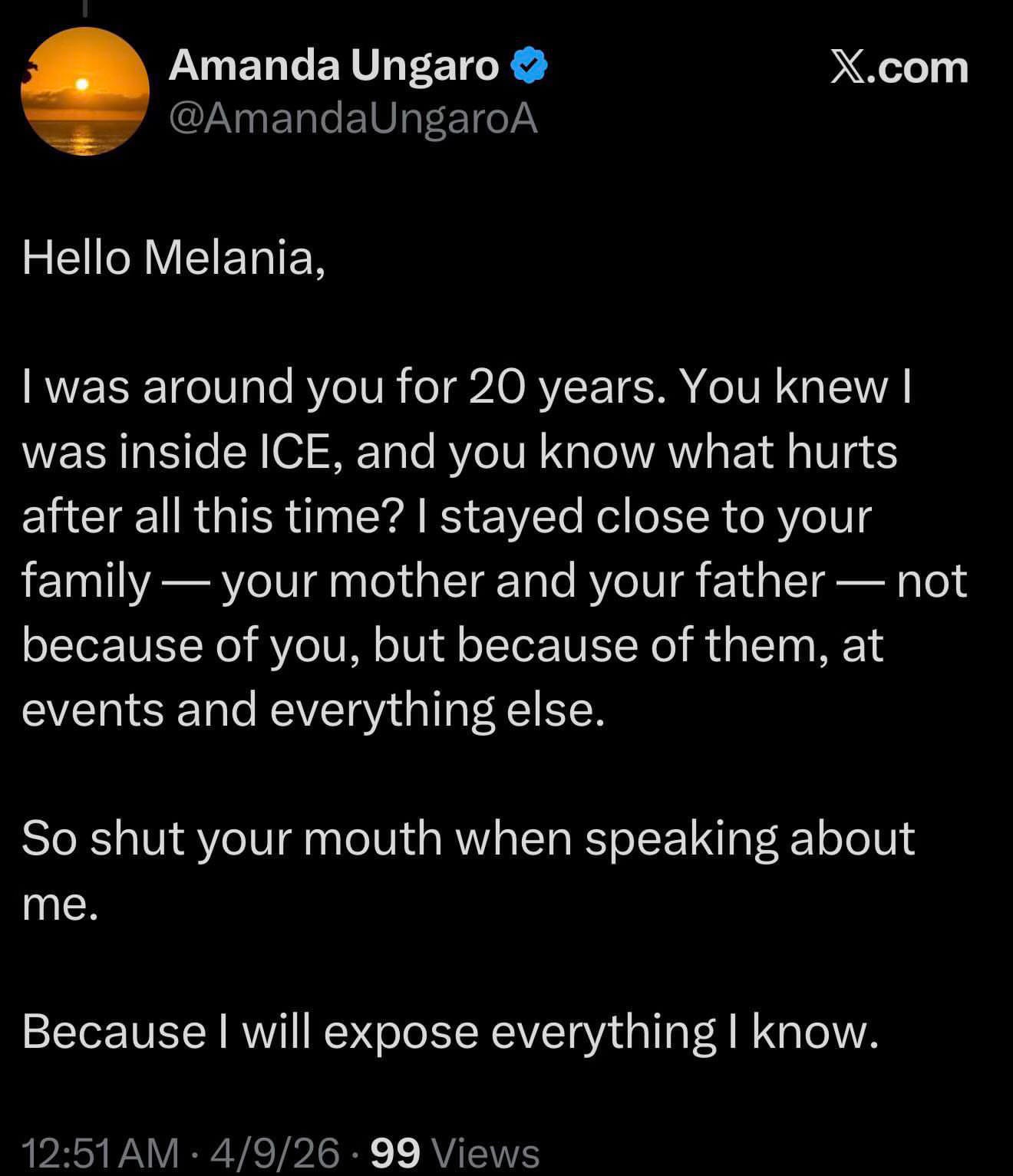
To understand why that post carries weight, you need to know who Amanda Ungaro is — because she is not a random name on the internet.
Ungaro is a Brazilian former model. She was 18 years old when she first met Melania Trump — on Donald Trump’s plane, traveling from Miami to New York — while she was in a relationship with Paolo Zampolli, who was 33 at the time. That relationship lasted nearly two decades. They have a teenage son together. During those twenty years, according to a New York Times report, Zampolli repeatedly dangled marriage and a path to legal status before her, then pulled it back. Her last visa expired in 2019. He never followed through.
She is also mentioned in the Epstein files, which indicate she was on Epstein's plane as a teenager.
In June 2025, Ungaro was arrested in Miami on workplace fraud charges at a medical spa. She was in custody. She had not yet posted bail.
Zampolli found out and made a call.
He contacted David Venturella, a senior ICE official, and explained that his ex was in the country illegally. Per the New York Times, Venturella then called ICE’s Miami office to ensure agents would pick Ungaro up from the jail before she was released. During that call, Venturella noted the case was important to someone close to the White House. Ungaro was taken into federal custody before she could post bail. She was ultimately deported to Brazil. Zampolli now has custody of their son.
Zampolli acknowledges making the call. He describes his motivation as “curiosity” — says he was asking about the process, not requesting a favor. The Department of Homeland Security says her arrest and deportation had nothing to do with political connections.
What is not in dispute: a woman who had spent twenty years inside this social orbit, who had been kept in legal limbo by the man at the center of it, was deported after he made a call to a federal official who cited his White House proximity as the reason to act. She lost her custody case. She lost her ability to return.
And then, from Brazil, she posted a warning to the First Lady of the United States.
Zampolli is not a peripheral figure in this story. He is the structural link between Melania’s entry into Trump’s world, the modeling pipeline through which she came to this country, a woman he kept visa-dependent for two decades and then had removed, and a name that appears multiple times in the Epstein files. Per those files, Zampolli and Epstein once discussed buying a modeling agency together.
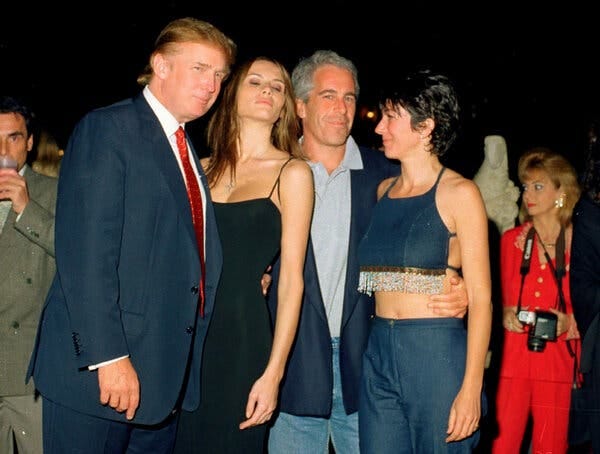
There is also a photograph recovered from Epstein’s home — found inside a drawer — showing Trump, Epstein, Melania, and Maxwell together.
Melania’s statement today said she first met Epstein in 2000.
The photograph has not been dated.

The System
None of this requires a conspiracy to explain. It requires understanding the system these people moved through.
The modeling world of the late 1990s and early 2000s was not just fashion. It was access. Young, often foreign women entered the United States through intermediaries who controlled their careers, housing, visas, and social introductions. Opportunity and dependency, delivered together, by people who needed you to be grateful for both.
NPR reporting on Epstein's network documented that his recruitment relied heavily on these environments. The modeling circuit was not the only pipeline. It was one of the clearest — a conclusion reached not just by investigators, but by more than three dozen Epstein survivors themselves. I've reported on this pipeline before. Read it here.
Zampolli operated fluently in that structure. He didn’t build it. He knew how to run it.
This is what gets lost when coverage chases individual guilt: the environment manufactured proximity wholesale. It normalized the connections before anyone thought to question them. So when fragments surface — an email, a photograph, a post from a woman claiming twenty years of access — they don’t appear from nowhere. They appear because they were never fully examined the first time around.
“Now Is the Time For Congress to Act”
Here is where Melania’s statement gets interesting and deserves scrutiny.
She closed by calling on Congress to hold public hearings specifically for Epstein’s survivors — to give them the opportunity to testify under oath, on camera, in front of the country.
This sounds like accountability. It is not accountability. It is a redirect.
Here is what Congress could actually do right now:
Roughly 2.5 million documents in the Justice Department’s Epstein investigative files have not been publicly released. Of the 3.5 million pages published, many are heavily redacted, including, critically, the names of co-conspirators. Lawmakers who reviewed unredacted versions of the files found that powerful men's names had been blacked out. Rep. Jared Moskowitz emerged from reviewing the documents saying there are “lots of co-conspirators” and that “they’re trafficking girls all across the world.” CNN
The DOJ has withheld roughly 3 million pages of documents and redacted hundreds of thousands more, based on privileges Congress expressly rejected in the Epstein Files Transparency Act. The law's own authors — Reps. Massie and Khanna — have said it isn't being complied with. Members are only allowed to review documents on four DOJ computers at a satellite office open only during business hours. At that pace, it would take more than seven years for members to review even the limited set of files DOJ has made available.
Congress does not need survivors to testify publicly to name co-conspirators. The names are in the files. The files are being protected. The agency now responsible for releasing them is run, in an acting capacity, by Todd Blanche, Donald Trump’s former personal criminal defense attorney.
Asking survivors to testify publicly is retraumatizing by design. It is spectacle dressed as justice. It centers the pain of the people Epstein harmed rather than the accountability of the people who enabled him. It is, in the specific context of a statement designed to redirect attention away from an inconvenient email and an inconvenient photograph, a very tidy closing move.
Congress can compel full, unredacted release of the co-conspirator files. It can enforce the law it already passed. It can subpoena the acting Attorney General, who is currently running the DOJ, while the Epstein files remain incomplete.
It does not need to put survivors on television to do any of that.
The Record
Melania Trump delivered a live, televised statement from the White House Grand Foyer on April 9, 2026.
Trump told MSNBC he was unaware of the statement beforehand. A CNN source says he was. Both things were said today.
The 2002 email to Maxwell is sourced from the publicly released FBI Epstein files. Melania acknowledged it. She called it a trivial note.
A photograph of Trump, Epstein, Melania, and Maxwell was found inside Epstein’s home.
Zampolli introduced Trump to Melania. He has stated he helped secure her U.S. visa. He contacted a senior ICE official following Ungaro’s arrest. He acknowledges the contact and disputes its characterization.
Amanda Ungaro publicly claimed twenty years of proximity. The screenshot is verified.
2.5 million Epstein documents remain unreleased. Co-conspirator names have been systematically redacted in violation of the law Congress passed to prevent exactly that.
What is not independently verified: The full scope of Ungaro’s claimed relationship with Melania Trump. Any allegation of criminal conduct by Melania Trump.
There is no verified evidence that Melania Trump participated in or had knowledge of Epstein’s crimes. That is not a hedge — it is the floor. What exists is documented social proximity, a sourced email reflecting it, a photograph placing her in the same frame as Epstein and Maxwell, and a response that used the machinery of the White House to frame the story before the story fully arrived.
What “Overlapping Social Circles” Covers
Melania Trump’s statement today established a baseline. She was not friends with Epstein. She was not a victim. She barely knew him. The email was trivial. The social overlap was normal.
That baseline will hold in the short term. First statements almost always do.
What it does not address: why a woman with no meaningful connection to Epstein had his first name on her fingers in a warm 2002 email to his primary enabler. What it does not address: the photograph. What it does not address: the woman claiming two decades of proximity who posted a warning hours before a White House response arrived.
The Epstein story is not over. It’s not even close to over. The co-conspirator names are in files still protected by the DOJ, now run by the president’s former defense attorney. The survivors whom Melania wants to see testify publicly have already been failed, repeatedly, by every institution that was supposed to protect them.
What they are owed is not a hearing. What they are owed is the full, unredacted truth — about who knew, who helped, and who has spent the last several years making sure the files stay incomplete.
That is what Congress can do.
The agency responsible for releasing those files is now run by Donald Trump’s former criminal defense attorney. The woman calling for survivor hearings gave her statement from the building where he works.