

Patterns
How Jeffrey Epstein Used Trust, Control, and the Language of Family.

Content warning: This article contains material that may be disturbing. Reader discretion is advised.
Patterns are how abuse survives. Every abuser has them. Once you know what to look for, they’re not hard to see. Like a dress pattern laid out on a table, each piece looks ordinary on its own. It’s only when they’re stitched together that the design becomes clear.
My ex-husband had patterns.
There would be an incident of abuse. I would get hurt. I would be hurt. I would withdraw. Then he would pull himself together — apologetic, attentive, almost convincing. That phase never lasted longer than three weeks.
Not once.
For every good day, there were at least fourteen bad ones. The abuse always returned when he was angry, when work frustrated him, when his family upset him, when he didn’t have drugs, when my family upset him. Sometimes it didn’t take anything at all. A mood shift was enough.
And when it came back, it came in every form. Physical violence. Emotional violence. Psychological violence. Sexual violence. He threatened to take my children. He told me no one would ever want me.
The pattern never changed — only the excuses did.
Once you’ve lived inside a pattern, you start to recognize it elsewhere.
Survivors, Abuse, and Pattern Recognition
Survivors learn pattern recognition the way some people learn a second language: not by choice, but by necessity. You learn how tone shifts before the blow. How apologies sound different when they’re real versus when they’re tactical. You learn the length of the calm before the next storm. You learn when to placate, when to disappear, and when to brace.
And you learn that abuse is rarely chaotic. It is structured. Predictable.
What makes abuse so difficult for outsiders to understand is that it doesn’t look like constant violence.
If it did, fewer people would stay.
Abuse survives because it alternates harm with relief. Fear with affection. Threats with promises.
The pattern is the point.
For survivors, that pattern doesn’t end when the relationship ends. It follows you into courtrooms, custody disputes, workplaces, and medical offices. It follows you into your next relationship. And your next friendship. And every single relationship after that.
You start to recognize the same dynamics playing out again — power rebranded as care, control reframed as concern, coercion masked as choice.
That’s why so many survivors recognize Jeffrey Epstein for what he was.
Not because his behavior was unique — but because it wasn’t.
The language in these emails is familiar. The escalation is familiar. The way promises are made and then withdrawn. The way dependence is created and then punished. The way reality is rewritten until the victim starts questioning their own memory. Survivors have lived this before.
What’s most dangerous about abusers with power isn’t only what they do — it’s how effectively they exploit systems that are already primed to doubt survivors.
Courts ask why you didn’t leave sooner.
Police ask why you stayed.
Employers ask why you didn’t speak up.
Friends ask why you went back.
Abusers know this. They count on it.
That’s why pattern recognition matters more than intent. More than motive. More than even individual acts. Patterns are the evidence survivors bring when bruises fade, when emails are deleted, when testimony is dismissed as emotional or biased.
And those patterns are exactly what institutions have been trained to ignore.

Jeffrey Epstein had patterns, too.
“I can’t believe the baby deal is another one of your patterns,” the sender writes, accusing Epstein of trying to convince her she imagined agreements he had made.
That’s how abuse works.
An abuser will make you feel small. They’ll make you feel unsteady. Like you’ve slipped into madness. They’re experts in undermining trust — in facts, in institutions, in yourself.
That’s what gaslighting looks like.
The language here is blunt, angry, and exhausted. This isn’t flirtation — it’s someone realizing that promises around having a child were being dangled, withdrawn, and rewritten.
What stands out isn’t just the reference to a “baby deal,” but the word patterns.
By this point, whatever Epstein was offering wasn’t an isolated promise. It was something repeatable. Predictable. And destructive.
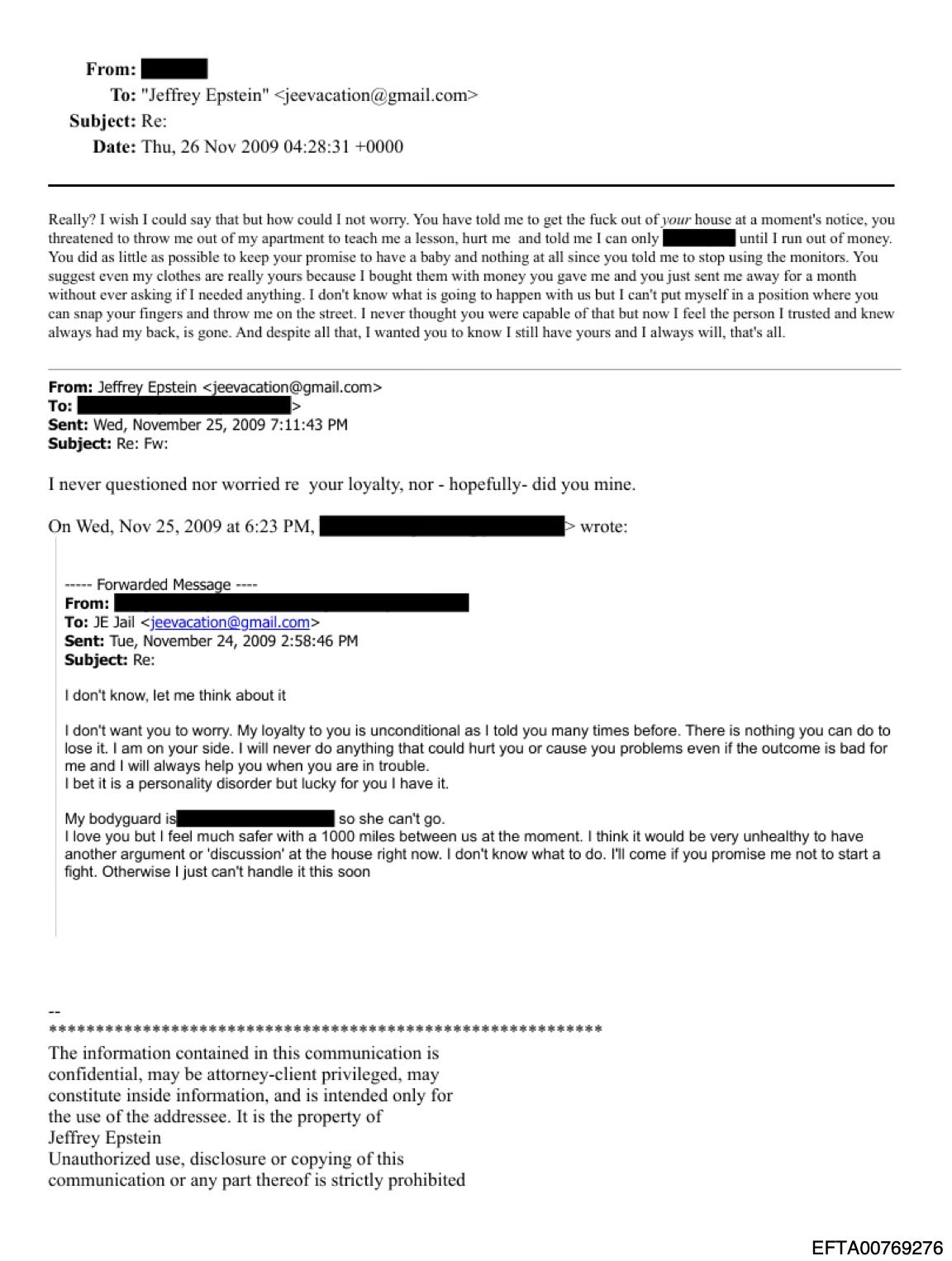
“You did as little as possible to keep your promise to have a baby and nothing at all since you told me to stop using the monitors.”
This is critical.
It is not a rumor, not a euphemism, not a third-party interpretation. It is a direct account of a promise made and then withdrawn. The same email goes on to describe being told to “get the fuck out” at a moment’s notice, threatened with eviction, and warned she could only remain housed until she ran out of money. This is textbook economic abuse: housing insecurity used as leverage, financial dependence created and then weaponized, threats of eviction used to enforce compliance. It is a pattern long associated with Epstein — and here it is documented in real time.
When someone dangles your life over your head, you comply.
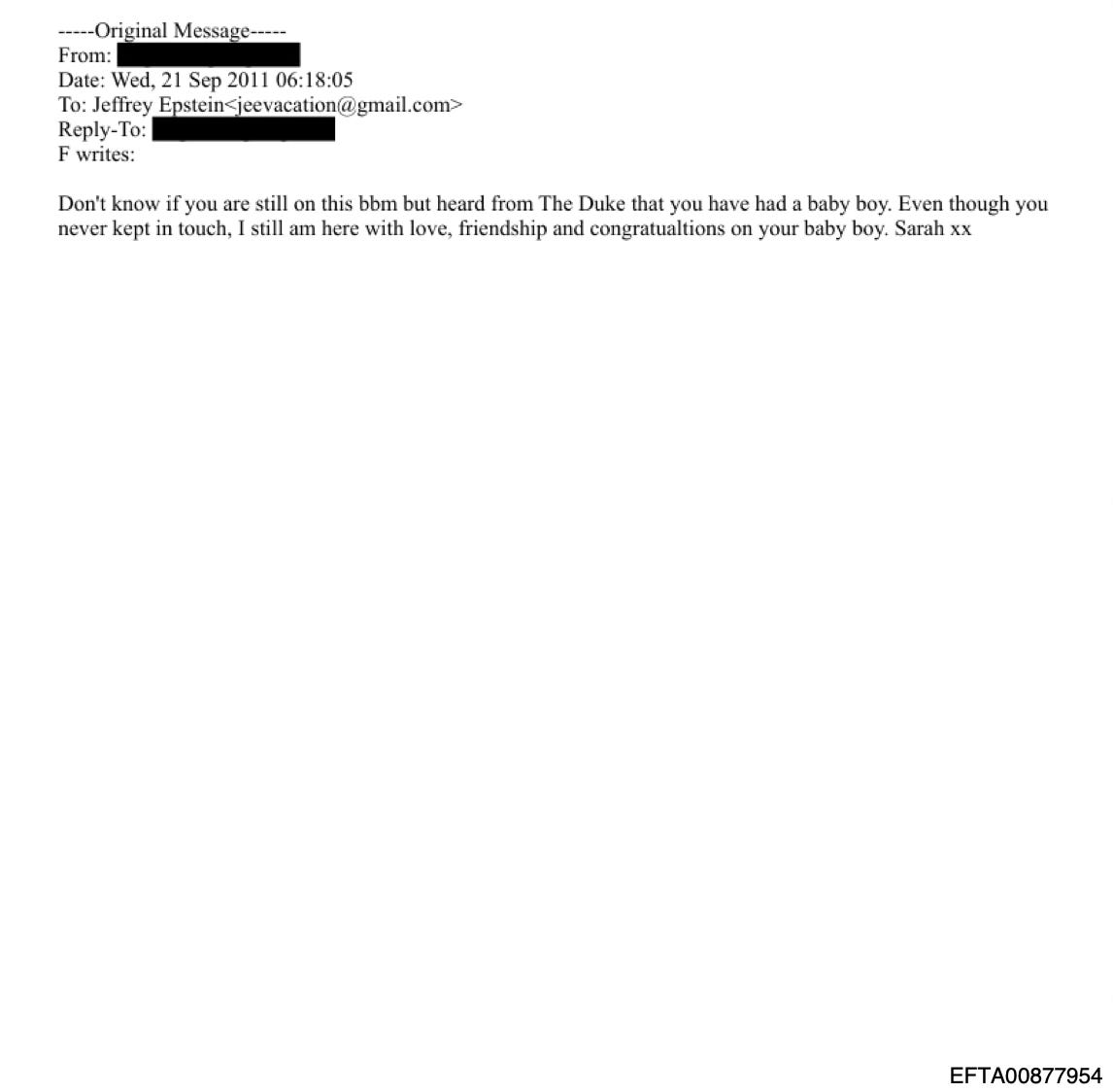
The monarchy is in crisis, and we are watching it unfold in real time. We expected to find former Prince Andrew in the files. Fergie’s relationship with Epstein, however, was not one I had on my Bingo card.
A September 2011 email from Sarah “Fergie” Ferguson — the Duchess of York and Andrew’s ex-wife — complicates the narrative in a way that’s hard to ignore. Writing casually, she tells Epstein she heard from Andrew that he had a baby boy and offers congratulations.
There’s no drama in the message. No hesitation. No sense that she’s repeating gossip or crossing a line by mentioning it. It reads like social information being passed along — something already accepted as true. The email doesn’t identify a mother or confirm a birth, but its tone matters. It suggests that, at least for a moment, the idea of Epstein as a father circulated comfortably among the highest elites, treated not as shocking or implausible, but as ordinary.
Taken alongside Epstein’s documented fixation on reproduction, his repeated promises to women about having children, and his own references to “the baby thing,” the question shifts. It is no longer whether Epstein wanted children — he clearly did — but how many may exist, and who bore them.
If children were born, they were never meant to be public.
And that, too, fits the pattern.

It was about positioning. About familiarity. About being embedded in people’s lives in ways that blurred the line between benefactor, authority, and family.
Epstein’s mother died in 2004. Whoever is referring to him as “Baba” in this email has known him for at least nine years by 2013.
This email from September 2013 reads casually. The sender calls Epstein “Baba,” a term often used to refer to someone as “father,” references “Mama,” and reminisces about Epstein’s mother as if these roles are long-established and understood. This is the language of family, used naturally and without explanation. On its own, it could be dismissed as affectionate shorthand. Placed alongside other emails involving promises of children, disputes over pregnancies, and Epstein positioning himself as a paternal figure, it becomes harder to ignore how often the language of family appears — and how deliberately it seems to be cultivated.
What does Epstein gain from positioning himself as a father or a paternal authority figure?
Trust.
Access.
Control.
Nicole Junkermann, a German countess, is another name tied to Epstein’s orbit. Her relationship with him has prompted her resignation as a trustee of The Royal Marsden Cancer Charity after dozens of emails surfaced in the Epstein file release.
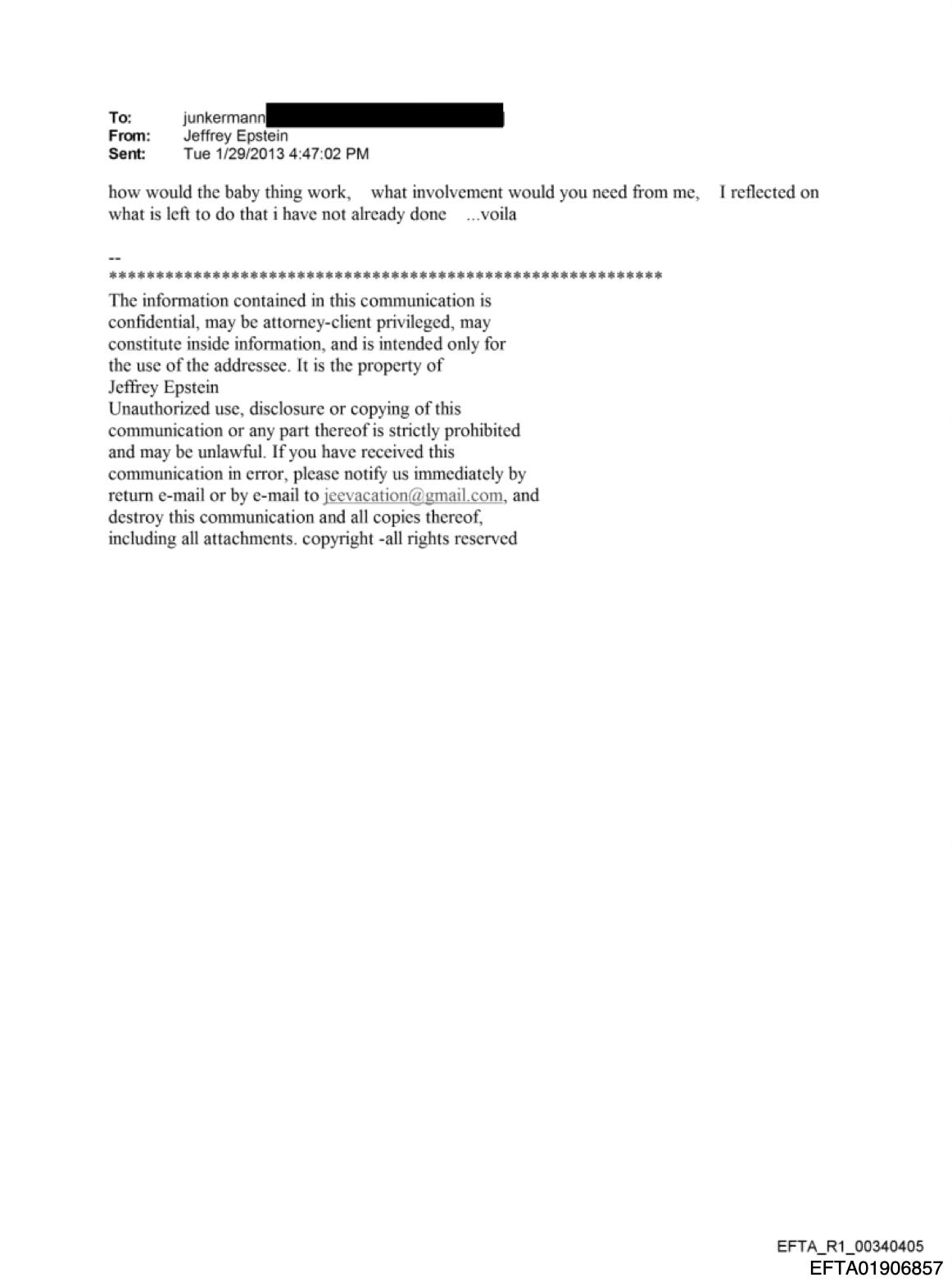
That context matters when you look at earlier exchanges with Junkermann. In June 2010, she emailed Epstein directly with the subject line: “Will you have a baby with me?” The message is brief and practical — “Where is the best place to do so?” — as if the premise itself required no explanation.
This wasn’t a spontaneous provocation or an abstract idea — It was a question posed plainly and treated as plausible enough to discuss logistics.
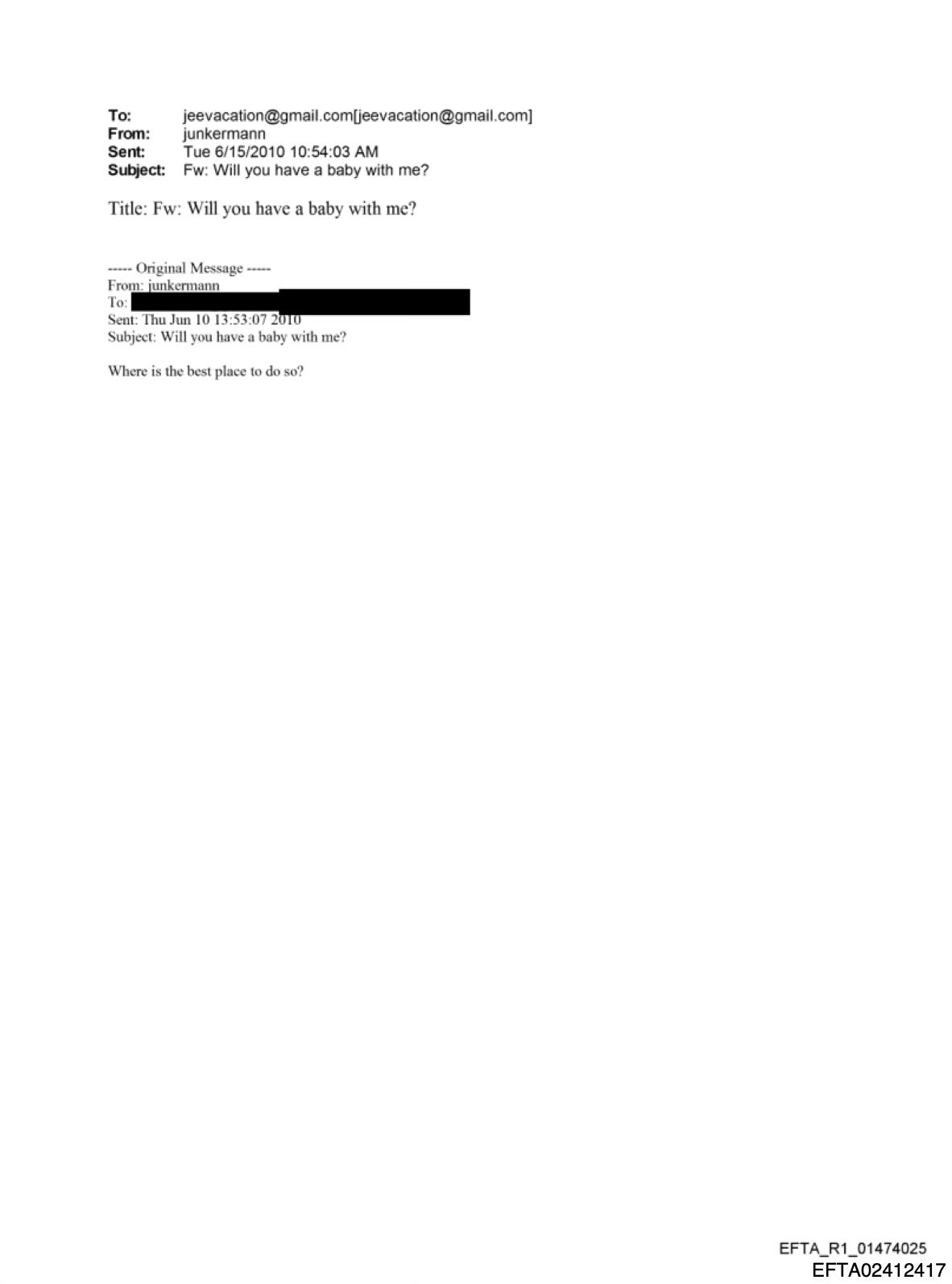
Placed alongside Epstein’s later message — “how would the baby thing work, what involvement would you need from me” — a pattern sharpens into view. This wasn’t a one-sided fixation or a rumor circulating without cause. It was an ongoing conversation, revisited over time, framed in terms of feasibility and roles.
Whatever Epstein was offering, entertaining, or implying, it existed within a shared understanding that having a child together was something to be considered, negotiated, and planned.
And that only works if trust is already in place.
And trust doesn’t just open conversations. It sustains them over time.
When a framework is established — where having a child is something to be discussed, weighed, deferred, or repurposed — it doesn’t disappear just because a message goes unanswered. It evolves. It resurfaces. It gets folded into other negotiations. What begins as a possibility becomes precedent.
By 2016, that framework was no longer implicit.
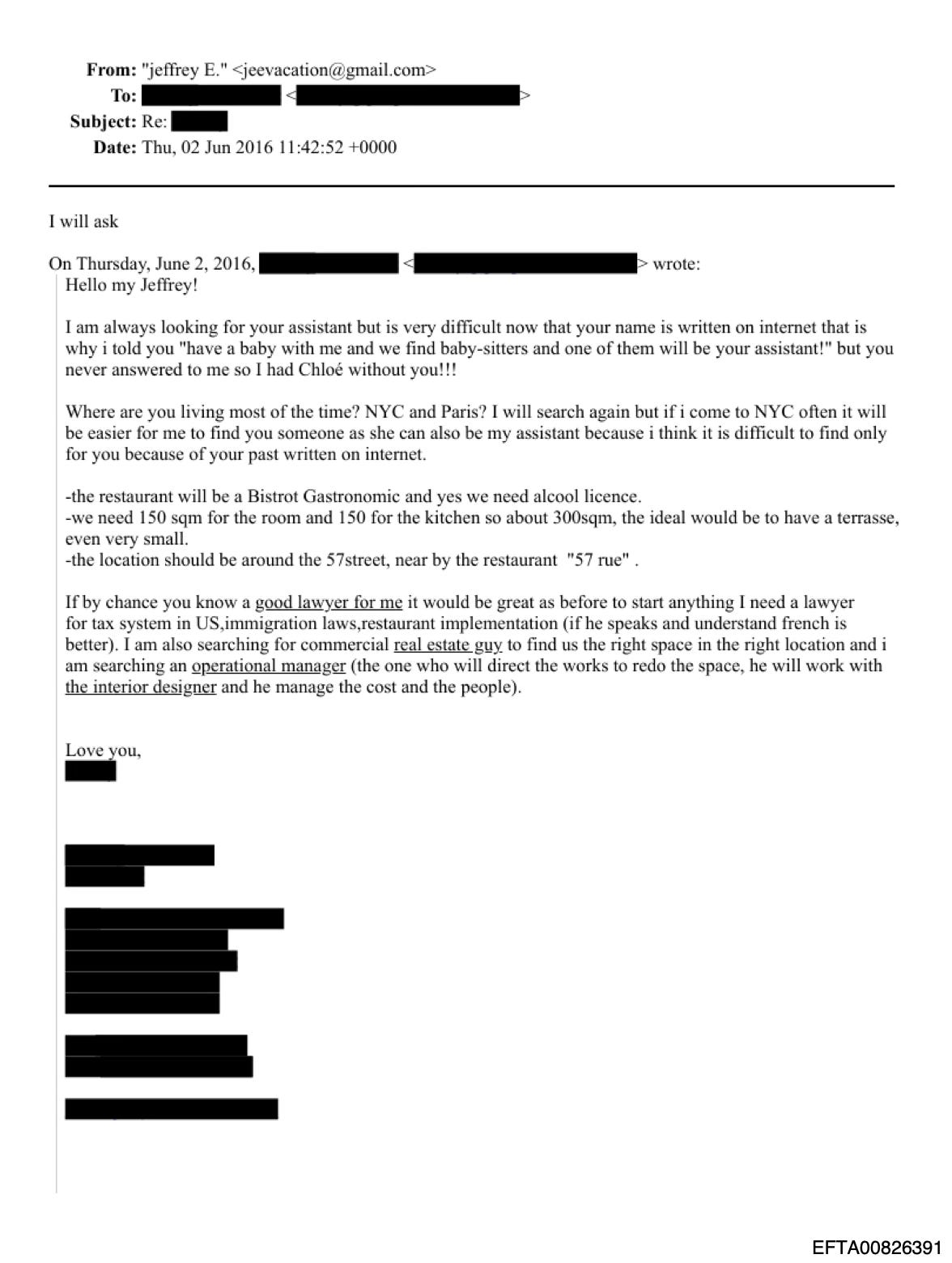
A June 2016 email lays the dynamic bare. The sender reminds Epstein that she once proposed having a baby together — framed not as a relationship, but as a solution: childcare, staffing, even the role of assistant folded into the idea of a child. When he didn’t respond, she writes, she “had Chloé without you.” The message moves seamlessly from reproduction to logistics — lawyers, real estate, restaurant plans — as if these things belong on the same continuum. It’s not romantic, and it’s not hypothetical. It reads like a worldview in which having a baby is transactional, instrumental, and interchangeable with labor. And Epstein’s reply — “I will ask” — does nothing to interrupt that logic.

And then the tone changes.
What had once been discussed in terms of feasibility and logistics collapses into something else entirely. By 2018, the conversation — at least with this person — is no longer about planning or possibility. It’s about denial. And fear.
An October 2018 email reads like a forced retraction. “It’s a total bullshit, my phone is hacked,” the sender writes, before insisting she never had a baby and describing how she “went crazy after miscarriage.” The language is frantic and fragmented, ricocheting between denial and self-blame. It doesn’t read like a calm clarification. It reads like someone trying to erase herself.
We do not know who this sender is. There is no confirmation that she is the same person referenced in earlier exchanges, and it would be irresponsible to assume she is. But the emotional texture of the message matters.
This email carries the imprint of fear. It reads as though something is being held over her head — not stated outright, but powerful enough to force a denial so absolute it turns inward. The urgency, the insistence that nothing happened, the willingness to portray herself as unstable rather than risk another explanation — all of it suggests pressure. Not persuasion. Pressure.
Placed alongside other emails that reference “baby deals,” broken promises, and disputes over whether a child existed at all, this message doesn’t resolve the story. It deepens it. It shows someone trying to claw back control of a narrative after loss — insisting nothing happened while still speaking from inside the wreckage of something that clearly did.
This is what coercion often sounds like on the page. Not explicit threats. Not clear demands. But fear that makes denial feel safer than truth. A reality where retracting your own experience becomes a form of self-preservation.
Once again, the pattern isn’t clarity.
It’s collapse.
Epstein had patterns.
There was at least one child — a baby boy. Other emails show that pregnancy itself was used as a mechanism of control, a way to bind, threaten, and manage women long after the initial abuse.
We’ve all heard the rumors — that Epstein was intentionally impregnating girls to “seed” the world with his DNA. What matters more than the rumor is what the records show: repeated promises around having children, disputes over pregnancies, logistical discussions about reproduction, and eventual denial and erasure. Taken together, they reveal a consistent strategy, not coincidence.
What these emails make clear is this: Jeffrey Epstein was an abuser. A predator.
And these are the very patterns advocates have been urging institutions to recognize for decades. If law enforcement, judges, lawyers, teachers, and leaders are serious about preventing abuse — not just reacting to it — those patterns have to be acknowledged early and taken seriously. Real, lasting change will require that kind of recognition. And it won’t be easy. If any part of this article feels familiar — or difficult — you’re not alone.
If you or someone you know needs support, the National Domestic Violence Hotline is available 24/7 at 1-800-799-SAFE (7233) or thehotline.org. Help is confidential, free, and available whether you’re ready to leave or just need someone to talk to.
This reporting remains open and accessible by design. If you believe in independent investigative work, subscribing (free or paid), sharing, or leaving a one-time tip helps sustain it.
You’re so right about narcissists using family language even to manipulate and ensnare their victims. An ex of mine was abusive and eventually I threw him out. I’ve seen him a few times since and he wants me back so he always calls me “honey” or other terms of endearment. I tell him not to because it’s not true.