



In Part One, we examined the structure of authority within the Duggar family and the broader framework in which that structure was situated. However, understanding a system requires more than identifying its organization. It also requires examining how that system responds when it is tested. In those moments, authority is not merely present — so are the mechanisms through which that authority is held and maintained.
The case of the Duggars is not only a matter of individual actions, but of a broader institutional response shaped by a narrowly defined framework of belief and authority. According to later statements from Jim Bob Duggar, the initial disclosure of Josh Duggar’s abuse of minors occurred in March 2002, when he, then fourteen, admitted to touching several of his sisters.
At that point of disclosure, a range of responses was available, including formal reporting, clinical intervention, and external oversight. Instead, the matter was addressed internally. Information was contained within the family and later shared with a limited network of trusted individuals, each step occurring within a structure influenced by the teachings of the Institute in Basic Life Principles (IBLP).
Within that framework, authority is not diffuse — it is organized and directional. Individuals are expected to operate within clearly defined leadership structures, with decision-making concentrated at the top and deference expected from those below. Conflict is typically addressed within the system itself, rather than through external institutions, and maintaining order is often prioritized alongside, or in some cases above, external accountability. These principles are not informal. They are reinforced through seminars, training programs, and affiliated initiatives that provide guidance on family structure, gender roles, and authority relationships.
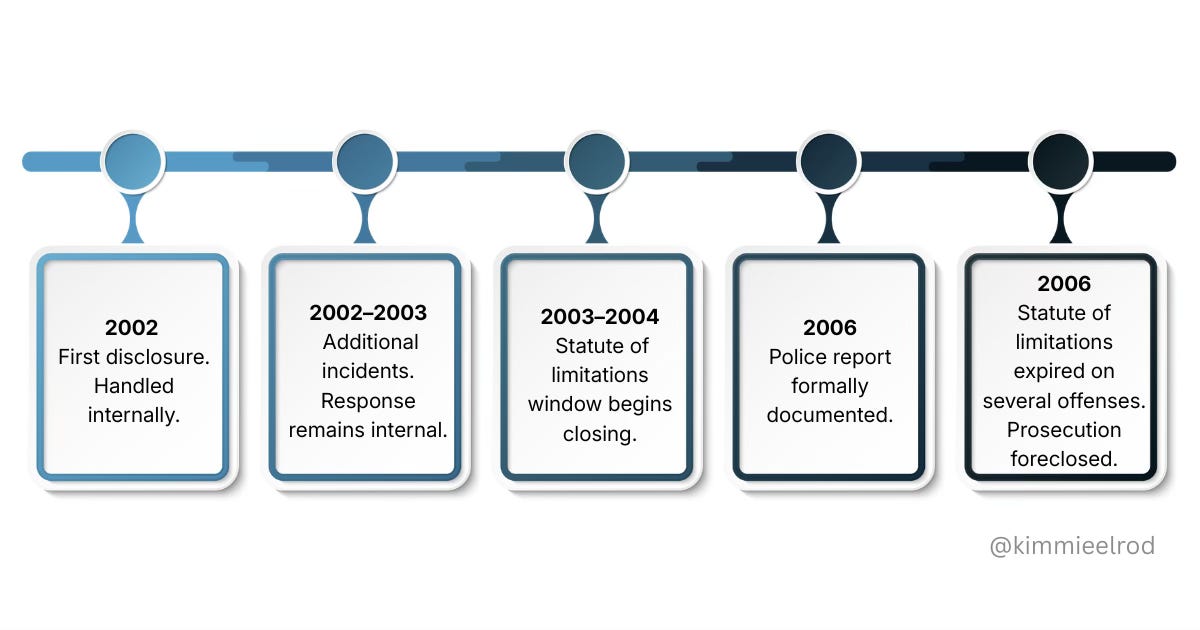
This pattern was not confined to a single instance. Between 2002 and 2003, additional incidents occurred, and the response remained consistent. The matter was handled within the family, within the church, and through programs associated with the IBLP. In practice, this meant that disclosure remained within a controlled environment shaped by shared beliefs about authority, obedience, and internal resolution. By the time the information moved beyond these boundaries to the point where it could prompt formal action, a significant period had passed.
The significance of this delay becomes clear when considered in light of the legal framework in place at the time. By 2006, when a police report was formally documented, the applicable statute of limitations under Arkansas law had already expired for several of the relevant offenses. While certain crimes, such as rape, were not subject to a statute of limitations, other forms of sexual assault were governed by more restrictive timelines. In many cases, prosecution was required within a defined number of years after the offense or within a limited period following the victim’s attainment of adulthood. Civil claims were similarly constrained, often expiring a few years after the individual reached the age of majority.
In practice, these limitations created a narrow window for legal accountability — one that did not always align with the realities of delayed disclosure in cases involving child sexual abuse. Delayed disclosure is well documented in both legal and psychological research, often resulting from fear, coercion, confusion, or the influence of authority figures. Legal frameworks have not always reflected these realities.
By the time the allegations were formally documented in 2006, that window had closed. Jim Bob Duggar, who had served in the Arkansas State House and operated within a network of legally sophisticated institutional leadership, was not an uninformed bystander to this timeline. The decision to handle disclosure internally and to delay formal reporting for several years had a predictable legal consequence — one that anyone with working knowledge of Arkansas law could have anticipated. Whether that consequence was understood, anticipated, or deliberately sought is a question the record cannot definitively answer. What the record shows is that the delay occurred, was managed, and that when formal reporting finally occurred, prosecution was no longer possible.
The timing of this disclosure is therefore not merely chronological. It is legally consequential. Once the statute of limitations expires, the possibility of prosecution is no longer contingent upon evidence or acknowledgment. It is foreclosed as a matter of law.
In this context, delay is not a neutral factor. Within a system that emphasizes internal handling and controlled disclosure, delay limits — and ultimately eliminates — the possibility of formal accountability. The sequence of events — an internal response followed by delayed external reporting — left legal recourse unavailable for earlier conduct. In this way, the structure of response and the structure of the law intersected, producing an outcome in which the absence of accountability was not incidental, but procedurally reinforced.
This intersection deserves to be stated plainly. A system that handles disclosure internally, within a closed network of shared authority, and that delays formal reporting — whether by design or as a predictable consequence of its own logic — will, in enough cases, outlast the legal window for accountability. That is not a coincidence. It is a function of how the system operates. The law, in this instance, did not fail independently. It was met by a set of conditions that made its failure structurally probable.
The Language of Containment
Alongside the issue of timing, the language used to describe the conduct warrants examination. Even after the abuse was acknowledged, it was consistently framed in softened terms — “inappropriate touching,” behavior described as occurring “over the clothes,” explanations that attributed the conduct to curiosity, not abuse. Such language does not merely describe events. It shapes their interpretation. It narrows the perceived scope of the conduct, reduces its apparent severity, and creates distance between the act and its impact on the people who experienced it.
Within the broader IBLP framework, this type of framing is not inconsistent with the emphasis on preserving order and resolving issues internally. Language becomes a tool of management as much as description. By defining conduct in less severe terms, it becomes more manageable within the system — less likely to trigger external intervention, more easily reconciled with existing authority structures. This does not change the underlying conduct. It changes how that conduct is perceived, processed, and ultimately addressed — or not addressed.
This pattern was also evident when the case became public in 2015. During a nationally televised interview, the conduct was again described in similarly limited, softened language. The framing remained consistent with earlier characterizations, emphasizing containment and a narrow definition of what had occurred. This continuity is notable. It suggests that the language used was not incidental or improvised but reflective of an established approach—one that had been applied consistently for more than a decade and across multiple audiences.
What is most significant about this continuity is not the specific words chosen but what they reveal about the system’s priorities. Across thirteen years — from the initial disclosure in 2002 to the televised interview in 2015 — the framing remained consistent. The system did not reckon with what had happened. It managed it.
What the Pattern Produces

The Duggar case thus reflects more than a series of individual decisions. It illustrates a pattern involving delayed disclosure, the use of minimizing language, and the controlled movement of information within a defined system. These elements operated within a structured environment shaped by the teachings and institutional practices of the IBLP, in which authority is highly centralized and internal resolution is prioritized.
It would be easier to treat this as a closed chapter — a painful history belonging to a family whose television program was canceled more than a decade ago. The record does not allow for that.
On March 18, 2026, Joseph Duggar, 31, was arrested in Tontitown, Arkansas. The charges stem from a 2020 family vacation in Panama City Beach, Florida, where a girl — nine years old at the time — reported that Duggar repeatedly asked her to sit on his lap, covered her with a blanket on a couch, manipulated her underwear, and continued to touch her thighs. She was fourteen when she came forward. According to the arrest affidavit, when her father confronted Duggar directly, he admitted to the conduct. Arkansas detectives later monitored a phone call between the father and Duggar, during which he admitted to it a second time. Joseph Duggar has been charged in Florida with lewd and lascivious molestation of a child under twelve and lewd and lascivious contact. He posted a $600,000 bond and returned to Arkansas.
His wife, Kendra Duggar, 27, was arrested separately on four counts of endangering the welfare of a minor and four counts of false imprisonment — all misdemeanor charges under Arkansas law. Both were given court dates for April 29. Joseph faces the same Arkansas charges in addition to the Florida charges. During the investigation, authorities inspected the home that the couple shares. According to a source cited by People magazine, locks on several rooms were found on the exterior of the doors.
Joseph Duggar is Josh Duggar’s younger brother. He grew up in the same household, under the same authority structure, shaped by the same institutional framework. He was on the same television program. He was presented to the same audience as an example of the same values.
That is not a coincidence to be noted and set aside. It is the point.
The Structure, Continued
To understand how such patterns emerge and persist, it is necessary to consider the broader institutional context in which these practices are embedded.

Founded by Bill Gothard, the Institute in Basic Life Principles promotes a framework centered on hierarchical authority, clearly defined roles, and the expectation that individuals operate within established chains of leadership. These expectations are reinforced not only through teaching but through community structures that shape daily life, relationships, and decision-making.
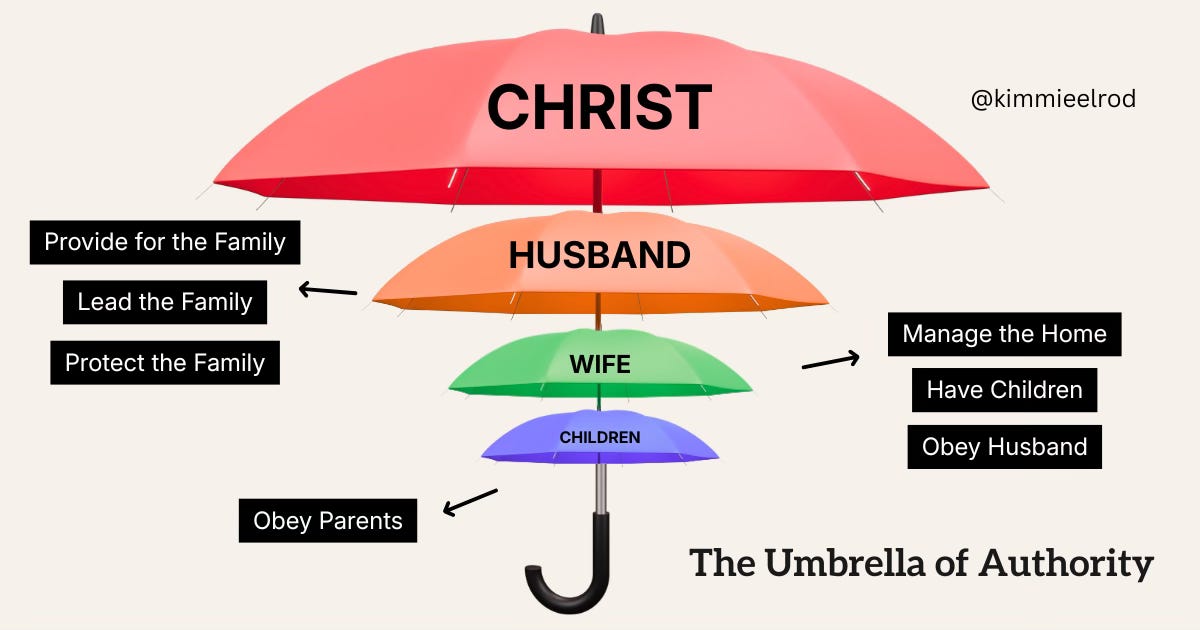
Within such environments, authority is not merely advisory — it is directive. Questioning leadership may be discouraged or reframed as disobedience, and compliance is often associated with moral or spiritual alignment. These dynamics can create conditions in which individuals are less likely to seek external intervention, even when harm occurs. Resolution is expected to occur within the system itself, often under the guidance of those already positioned within its hierarchy.
What the Joseph Duggar arrests make visible is something the Josh Duggar case alone could not fully establish — that the system described in Part One did not produce a single anomaly. It produced a pattern. Two brothers. Two sets of charges involving children. One household. One framework. One institution standing behind it, providing the language, the structure, and the justification for the response at every stage.
A system is not defined by what it prevents. It is defined by what it consistently produces.
When examined in this way, the response observed across the Duggar cases is not unpredictable.
It reflects the structure from which it arose.
What comes next is the harder question.
The IBLP did not exist in isolation. It existed within a broader cultural and political movement — one that found in the Duggar family not an embarrassment to be managed, but a useful image to be amplified. Understanding how that happened, who enabled it, and what it means for the present requires examining the infrastructure behind the image.
That is the subject of Part Three.